


Questions about the Steirische harmonika
 | |||||||
|
| ||||||
|
| ||||||
|
| ||||||
| |||||||
| |||||||
| |||||||
|
|

The " Steirische" is also my favourite instrument. Best thanks to Hermann Haertel for his affectionate introduction. I usually call the "Steirische" simply harmonika in contrast to the accordion (PA), this monster with its piano keys, on which I started to make music.
Regarding the Steirische, questions have been addressed to me again and again. So I want to answer some of these frequently asked questions here in advance, all of the following text is my
private opinion. With all off these questions you may have your own opinion and you even should have your own opinion, it would make me happy to become acquainted with your opinion.
What is a Steirische harmonika?
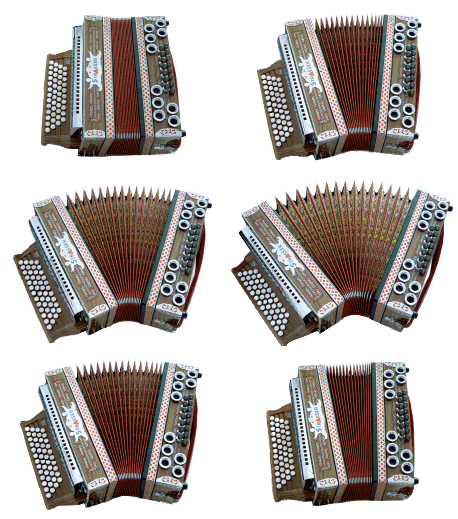
"Steirische" is a diatonic, bisonoric accordion arranged in three to five button rows, each row is tuned to an individual diatonic scale a 5th apart from the next row. Diatonic in this context means, that in each row only the seven tones for one scale are present. Bisonoric means that on pressing and pulling the bellows while depressing the same button two different tone pitches are heard one on press and other one on pull.
There are several designs of diatonic accordions, Vienna style diatonic accordions which usually don’t differ a lot in key layout but usually they don’t use a Gleichton, as for instance the club model with scales in two and a half rows two rows are diatonic scales and the inner row is used for accidentals, in addition, in England, wide-spread in Germany, France, Switzerland and Italy there are regional designs, frequently only with two rows.
On "Steirische" the major chord tones (fundamental, 3rd, 5th) sound out the respective kind of scale on push, and of course in principle with small exceptions the tones of the major 7th chord notes in pull direction. Some accidentals can be found on other rows, certain accidentals are usually not installed.
There are, however, already a lot of instruments, which use additional accidentals on auxiliary buttons on the lower end of the keyboard more about this in some other answers.
Which instrument to buy?
Actually nobody can answer this question except you. You must like the sound, of the instrument, and you must master it technically or with the skills you have or get. I would like to offer here no recommendation for a certain brand or type, only some
topics to think about.
How many rows?
For alpine folk music the 3-row instrument is usually sufficient. There is not one traditional alpine folk music that needs more rows because it uses more than 3 scales at the same time. However in many tunes - accidentals (tones from other scales) often falsely called half tones - which are to be found on instruments with more rows – are useful to have. Also when singing along with the instrument, it is preferable to have several keys to select from.
I recommend the 3-row Instrument for beginners and particularly for children, since it is nevertheless easier for learning. For progressing it is surely better, to have a more versatile 4-row Instrument. The 5-row is more complicated and already rather heavy and particularly for the right hand, the inner row is difficult to reach, therefore one rarely uses it.
Auxiliary buttons on the treble side can bring in missing chromatic tones (half-tones). It depends a lot on what one likes and the music one plays. Since there are several possibilities for it and it is not standard, I do not use accidentals in my Griffschrift at all.
For some difficult tunes auxiliary buttons are of great advantage. One can assign these keys with tones, which one does not find otherwise or only with a change of bellows direction.
From time to time one sees instruments with
extra buttons on the inner row. But it is not common yet to add extra buttons and there is absolutely no standard for which notes the keys are to be used. Very often these keys are used to add accidentals. Very often accidentals are added in such a way that on the lower or higher end keys are used for accidentals. I don’t like this since these keys do not fit into the logical diatonic arrangement. It needs a lot of training to use these keys. They are played very often only with the use of the thumb. Usually the thumb is used to stabilize the instrument. But if you can get used to it, it is possible to play music that would not be possible to play in the other case.
Which kind of scale?
With which instrument do you want to play along? This ought to be answered first. If you play on your own, it may be that you will find very often Bb-Eb-Ab a relative deep sounding scale. Some like this more. This scale is suited to play along with brass instruments. Woodwind Instrument often prefer G-C-F (recorder) C-F-Bb (clarinet). Stringed Instruments like violin or guitar prefer to use scales like A-D-G or C.
If you want to sing along with the harmonika, then the optimal pitch depends on your vocal range. The highest pitched scale which is singable, and which sounds good, determines the kind of scale. All kinds of scale with “#” are more suitable for singing, but I would not like to make this a rule.
I play along with the clarinet with a 3-row C-F-Bb without problems. In combination with a violin I prefer my 4 row A-D-G-C instrument with extra alternating bass keys. Both instruments are with two sets of reeds (MM) and for me this is sufficient.
Key allocation
The tones found on a Steirische depends on the scales for which it is designed. Christian Amon shows on his Website. You will find all models with all possible key layouts produced by the company Oellerer for the treble side and for the bass side as well. Best thanks for this deserving work.
They can probably determine the key allocation for your own harmonika on these
sites
too.
Which design?
Two reed sets or three? That is also a matter of opinion. However it has not only an effect on the sound colour. It also depends on how big your muscles are. It needs a bit more power to drive 3 reeds instead of 2. Playing is not only pure joy, but also hard work. Three reeds need much more air, therefore much more force is needed, not to talk about the fact that it adds to the weight of the instrument. If you are a strong, young man, may be you don’t care. Three reeds do have a somewhat smoother sound, and are louder, it fits therefore a little bit better with wind instruments or the “Tanzlmusi” (Dance-floor-music).
It is similar with the operating smoothness of the
key action. You should try that out for yourself. Low-friction keyboards require less strength in the fingers, and permit faster, more precise runs, but as a result, particularly beginners, often press a button erroneously, one which they did not want at all.
Much or little tremolo, that is likewise matter of opinion. Each tone is tuned so that it results in some beat in the sound. This means that 2 or 3 reeds that build a single tone are not tuned to exact the same pitch.
Increased beating, leads to a stronger Tremolo, with increasing tremolo the tone becomes more and more screaming and louder and therefore gets more in front compared to other instruments or background noise, Softer with less tremolo, does sound gentler, or more beautiful, more unobtrusive sound, too little brings less beating, flat tremolo reminds one of the flute, and it sounds no longer like a Steirische, is not as easily heard as with more tremolo in interaction with other instruments. Very strong tremolo is often preferred by solo dance music musicians, since the want to be heard with their Steirischen across the whole dance floor without a microphone. It depends to a great extent on the other instruments in the group as well if one plays not on ones own and also on the style of music one prefers.
The company Oellerer in Freilassing/germany tune their instruments per customer's request individually in the following gradations:
|
very flat | ||
|
flat
| ||
|
somewhat flat | ||
|
somewhat minus | ||
|
medium
| ||
|
somewhat strong | ||
|
strong
| ||
|
very strong
|
Cheap instruments of some companies are frequently sold with a lot beating, because irregularities in the tuning are then not so apparent, and faster and cheaper work is possible.
If you want more information on this subject go to:
www.hermode.de you will find a headline: "historical".
Which bass system, a minor or transition basses?
For me minor chords are important on the bass side, since in the alpine folk music minor chords occur again and again, as 2 step or as 6 step progressions, or even as entire minor tunes. Traditionally in Styria, Steirische with minor bass systems were always built in the past. Today one must request this system at purchase specially, or the adaptations have to be done in addition, they no longer standard. Particularly in Bavaria and western Austria nearly all Steirische are fitted with transition basses and/or doubled fourth step progressions in different designs. Too bad, because thereby the full breadth of our people’s music can no longer be played.
Through the use of minor chords it is possible to play most alpine folk music harmonically correct and as it was, otherwise this is not possible or only possible with some compromise. I would also like to be able to play certain minor tunes, for instance the folk dances "Topporzer Kreuzpolka" and "Warschauer " and the “Herkuleswalzer” and a lot more very popular local folk music, or other Viennese songs I would also not like to miss. I recommend installing the traditional bass with minor chords.
However it is possibly easier to play, simple pieces with transient basses, without minor chords. For me it is, however, illogical to make simple pieces still more simple in playing and at the same time not be able to play harmonically correct and with more variations.
In a supplement I show well known
bass systems for the 4-row instrument. There are, however, far more different systems than I can show here.
Is a more expensive Instrument better?
If you think so, then it may well be the case. There are differences in quality, better tone woods for the case, different quality of reeds, more durable keyboards, better keyboard action and much more. In many cases the difference in price is more in relation to the appearance of the instrument. Handmade “Federkielstickerei (feather-quill-emboidery)” or handmade wood carvings, or maybe the instrument has a very famous name or a prominent person promotes the instrument.
For me the Steirische is a
music Instrument. It is used to make music that should sound as good as possible, like a violin or a brass instrument. Nobody thinks to apply to the violin decorative parts like sparkling nails or paint “Edelweiss” onto the instrument, or even thinks about it to carve the instrument with various decors. You don’t even find it a lot with PA’s. Only the Steirische applies it in nearly every case. Sad in some ways, because it shows that it was not really respected(?). Some even think it is not even comparable to other instruments used in orchestras, this may have been one reason why one had to decorate the outside to make it more valuable.
Where can I get a Steirische?
|
New ones you could get at some shop selling music instruments somewhere near to you. But you should look for information first, you should know what you would like so they don’t sell you anything they want to get rid of. And most of the shops do not sell every make, and some don’t know a lot about Steirsche even though they sell the instrument. |
|
Or direct at the factory: You find a list off known factorys Harmonikaerzeuger |
|
Used Instruments are very often also available at the various accordion builders.Since every builder or seller usually takes the old instrument as part of the payment for the new one. |
|
You could place a notice in some public groups too for example:VolXmusik.de |
|
Or you may bid on www.ebay.de. Good luck. |
Which music tunes can I play on the Steirische?
The Steirische is used as an alpine folk music instrument. Some believe only this kind of music can and should be played on it. I personally don’t see it that narrowly. If it is technically possible, I also play other music if I like to, and I must say folk music gives me the most pleasure. And then there are technical limits. On this diatonic instrument we only have the option to play in three or 4 complete major scales at the same time. We have minor chords if installed but these minor scales are the natural parallel minor scales. Tunes in minor are somewhat more difficult to finger for harmonic minor and for melodic minor some tones are not available at all. Some reachable only with difficulty or with added accidentals. Diminished chords are not installed at all.
I was asked to provide the Blue Danube Waltz as Griffschrift. This is sometimes called the secret national anthem of Austria. So it is impossible to deny the right to play this music on a Steirischen.
So, as the composer imagined it, it was not possible to perform, and each new arrangement the extent of the changes necessary for it to work changes the character of this piece too much. Which is at the most possible according to my opinion, I tried to show the Vienna march of Johann Schrammel: Notes/Wien bleibt Wien, and Griffschrift: Griffschrift/Wien bleibt Wien. The tones that are missing on this instrument I set in the note picture as small rhombuses a semi-tone lower in each case.. These tones do not agree with the original and should be omitted when interacting with other melody instruments.
Since certain chords or tones are missing on Steirische, one is easily tempted to cheat. In this case it is important to think abut this note and make a decision about how important this tone is in the melody, or as a chord. And this question, everyone can solve himself - I think. If you play a piece gladly, then you play it in such a way, that it is possible for you, even if Mr. Schrammel wrote it differently. If it sounds terrible for you, then you might rather leave it.
How one can learn to play?
(allegedly) the preferred method is to set oneself in front of ones grandfather sitting opposite him and to copy a piece note for note. This is also a very good method, however only if you can find a suitable grandfather. If necessary a friend could replace the grandfather. I wish you much success in finding a friend who is willing first and then has the patience in addition for playing in front of you. Second lets hope he already knows how to play well enough, in order to teach you nothing wrong.
In some schools of music the Steirische is taught, unfortunately there are still far too few. Here this is often done with Griffschrift. However some music head masters have developed their own kind of Griffschrift.
Naturally, there are musicians who play Steirische nearly everywhere, who are often ready to pass on whatever they are able to teach. Everyone thus has their own teaching method and their own training works.
You can visit various courses or workshops, on weekends, near me in Lower Austria, or the “Musikantenschulungen der Volksliedwerke und anderer Verbände“ training courses and other federations, in connection with one’s vacation. You can get the basis for playing in one weekend; in order to really learn to play Steirische, though, a whole week is not sufficient by far. Some need a half-year, for most people it takes a year or even many years.
For private study I recommend the
"Griffschrift". Some ear for music and prefferably also some knowledge about
standard notation would be helpful in addition. Nevertheless I know some really good players, who taught themselves the playing, some already outside school, and some after their retirement. In addition there are many suitable training books, I list some on the page
"school works".

[Bass systems on the „Steirische Harmonika" english]
[Deutsche
Version]


