



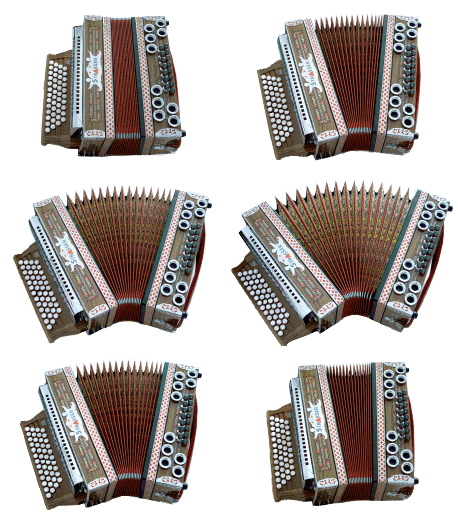
Playing technique on the "Steirische" harmonica

Where is the "C" on my instrument?
Yes, where is it, the "C", with which all note readers begin to read notes? For me that is unimportant, it is of no interest to me, at least not in the sense, which is usually meant with this question.
If I am then asked, the beautiful german song “Fuchs du hast die Gans gestohlen” begins nevertheless with C", then I must unfortunately answer, this awful song, with which my schoolmates annoyed me at school in my youth, begins on my instrument with the "D", on my second instrument perhaps it begins with "Bb", on another with "Eb", but it always begins on the second button in push direction. The 3rd button below the Gleichton. The only important thing is the relative location in respect to the Gleichton. The beginner can use the Gleichtone key, to find the location of other keys of the respective kind of scale too.
And then if you still want to know, where the "C" on your instrument is located, then look at the key layouts of Christian Amon.
But then how can I play in a certain kind of scale, for example in C major?
You cannot do this in the same way on all instruments, or sometimes not at all. If your instrument is not in the scale of C, this is not possible. You can play everything, which corresponds to your playing skills and knowledge, but mainly in the scales, which are built in on your instrument. If the tune is in some other diatonic scale, you must transpose to the scale you have on your instrument.
The Griffschrift notes published on these web pages are partly too difficult to finger for you?
My notes are to a great extent set for two melody parts, which can be played each on its own on different Instruments. If you want to play along with an accordion, zither or comparable instruments therefore, omit the second (usually lower) voice, or if you want, do it just to simplify the playing for you on too difficult passages.
This applies also to the Griffschrift Tabulature on Steirische. Play, all technically too difficult passages, as single keys. It would be favorable however, if you omit the second melody line and use the main melody line, that is with the Griffschift not always the higher written button. However it is the highest sounding note or key of the notes. Bass keys numbering you can vary as you like, you can simplify the alternating bass to simple accompany bass, You can leave away 3rd bass keys or leave away bass runs.
My instrument runs out of air too fast
Naturally it is possible that the Instrument bellows is leaky. Perhaps you should examine this once, squeeze the instrument together, without playing any notes. If you loose air noticeably, then really you should repair the good piece.
More frequently the question is meant, that with long push or pull passages nothing works any more, although the tune is not finished yet. The bellows is at its end and simply can not be expanded or closed further.
In order to avoid this, there are several techniques
 |
If you know in advance, the fact that you have to pull or push very long on the following part, then you should get additional air before, during previous pushing or pulling, press the air button a little bit along with the played keys. The listener should not notice this. |
|
If it happens to you that you run out of air during playing, (or if the passage are much too long, which sometimes also occurs) you can use small to very small tracing (small bellows reversal), in order to quickly get air again. One should practice this, so that the listener does not notice anything of this small trick. |
|
Advanced players can change from pull to push on the next outer row while playing (or instead of push, pull on the next inner row ). Bass keys have to be changed too, the bass keys belonging to the new row. Conditionally however another Griffschrift would be the result, this change in push direction should not change the sound, it should result it the same pitch, sound and colour of tones. |
Does an instrument need two shoulder straps?
Good players in Styria and elsewhere often play with only one strap. That has obvious advantages: Particularly if the musician is performing in a standing position, the instrument holds more firmly to the body, and is not wiggling around. One of the two straps can slip from one’s shoulder. In sitting position the Instrument can be slung quickly over one shoulder, and then quickly removed again. The only apparent disadvantage is, the way one has to slip into the strap with the head and the left arm for playing in a standing position, easily disturbs the hair-style. A further disadvantage, but only for beginners: One hardly sees the buttons.
However - I played for more than two decades with only one strap, then I got physical problems and back pain. My explanation was the load of the box was a bit one sided with one strap . My physical problems did go away by doing some gymnastics, nevertheless I now play again without problems and with two straps. I don’t use these back clips which are sometimes seen, so I don’t need any help from someone else when I take up the
Instrument. If from time to time one strap slips off I don’t have a problem because, I play with one strap without any problem too.
Do you want to try it? One s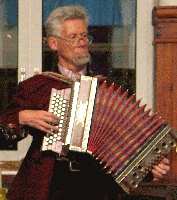 lips the left arm through the strap and passes then (or at the same time) the head through the belt, so that the belt crosses diagonally from the right shoulder across the back to the left hip.
Does one play with four or five fingers?
I started learning first with the piano accordion (all in all 4 hours with my piano teacher), and played in the usual way with 5 fingers of the right hand, I carried this on, when I changed to Steirische. If I want, I still can play with 5 fingers, however I did convince myself later, that it is better for me to play the treble side with only four fingers, the thumb remains laterally at the thumb groove.
This has several advantages:
|
Played in standing position or moving around while playing, one does not loose contact with the keyboard and the correct keys. |
|
The most important probably is: with some exercise one gets a distance feeling, the thumb hardly changes its position, the other fingers find the correct buttons better even with somewhat larger melody jumps. |
|
The thumb is substantially shorter than the other fingers, and is rotated relative to them, it would be more difficult to hit the correct keys unless one bends the hand more than usual. |
|
Such an unnecessary bending of ones hand, has to be regarded not only as ugly, but also in the long term as unhealthy. |
|
The hand appearance with the four-finger system looks more elegant to me. |
As you see in the picture, the right elbow is stretched away from the body, the bending of the hand is natural, nearly straight, the fingers bent a bit, and touching the buttons.
In principle the same applies also to the left hand in the bass strap.

[Deutsche Version]


