
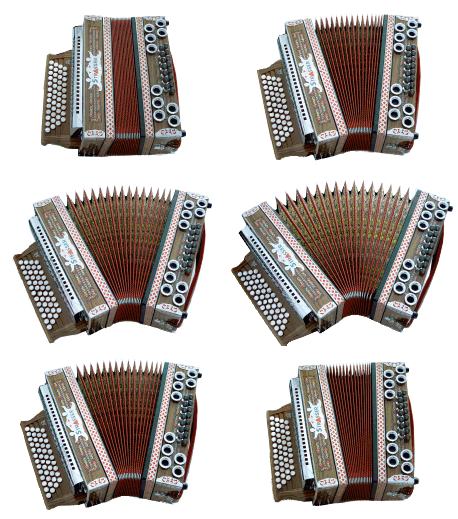
Bass systems on the „Steirische Harmonika"
(four-row)
I list here only some systems well-known to me, there are still far more. (and if it makes you happy, you can order your own Instrument version from a builder) In order to make comparisons possible, I take a 4-row Instrument A-D-G-C as base. For Instruments with different keys, they have to be transposed accordingly. On Christian Amon’s Pages you find more about the selection of bass systems, and all in the most diverse common scales. Best thanks to Christian for this deserving work.
To the 3-row Instrument D-G-C the same pattern applies predominantly, however there are fewer buttons present on the treble side and on the bass side, thereby less possibilities for different scales and bass runs.
It is common to all systems that (at least) four different scales are playable in major, with the possibility of bass steps, 5. and 4 progressions. The differences refer particularly to the playability in respect of minor scales (Step 2. and 6. progressions) and bass figures.
 | |
| |
| |
|
System "Hans Auer", derived from the "Bohemian system", 16 keys |
| |
| |
|
Each of these systems has its pros and its cons. Which system is most favourable for you, depends on your knowledge and your preferences. More buttons have obvious advantages on the bass side. In addition, they are more difficult to learn. And the more buttons based on the same design standards, the more heavy your instrument will be, the more strength it needs, in order to use it. In addition all these sophisticated Instrument types do not only have more bass buttons they also have more treble buttons, which is fully justified, but they do not harmonize with the original system, therefore they are learned with difficulty , and increase the weight of the instrument. Perhaps you should ask your teacher, which system he prefers.
|
If you want to play bass melodies or difficult bass figures, in several different of scales, then the systems "Gmachl" and "Schaborak" are particularly suitable for you, although all other systems likewise make the bass melody play possible. |
|
If you want to play minor melodies, which occur again and again in the alpine folk music or in the alpine folk dances, this you can see if you have a look at the notes published by me, then the traditional „Steirische“ with minor keys is suitable for you (minor in pull direction), it is also quite well playable with Gmachl system (minor in push direction), and Pascher (minor in pull direction). |
|
You Want neither the one nor the other , and not only as beginner, but also in the future you want only simple folk music melodies in major – “zwei glatt zwei verkehrt” (two plain, two reversed?) - then for you the (Bavarian) normal bass system, which is surely somewhat easier to learn and to play. |
|
If this applies to you, but you think in the future you will nevertheless play somewhat more but surely no minor at all, then "Hans Auer" or, "Anton Gmachl" and "Dieter Schaborak" is better, in order not to have to relearn later. |
Traditional styrian system with minor (15 keys)
Originally the two neighbouring chord keys (fis) were coupled. Usually the outermost bass keys (E) are coupled on the 4-row Instruments today, in order to provide the possibility of “Wechselbass” (alternating bass) play on the A-row (outside row first row). On push, only major chords are present.
| Key allocation bass four-row A-D-G-C,
push traditional styrian system |
|||||||||||||||
| E | e | B | b | Fis | fis |
E | |||||||||
| C | c | G | g | D | d | A | a | ||||||||
On pull, two minor chords are present on the internal row. They can both be used easily as, Step 6 progressions (minor scale with associated Step 5 progressions Dominant chord on push) or as Step 2 progressions of the associated scale (if necessary, likewise with associated Dominant step 5 chord).
| Key allocation bass four-row A-D-G-C,
pull traditional styrian system |
|||||||||||||||
| F | f | E | e-minor | B | b-minor |
F | |||||||||
| G | g | D | d | A | a | E | e | ||||||||
These minor progressions are possible:
|
B-minor in pull direction with accompanying Dominant step 5 progression chord Fis on push, or as 6. Step progressions in combination with D major (push) and as Step 2 progression of A major, this is comfortably playable |
|
E-minor in pull direction with accompanying Dominant step 5 progression chord B on push, or as 6. Step progressions in combination with G major (push) and as Step 2 progression of D major, this is comfortably playable |
|
A-minor pull as leading uncomplite minor with chord bass (pull A + f major chord) with E major chord on push is easily playable, does not sound good on all Instruments, has to be tried, depends on the tuning of the Instrument. |
|
D-minor 7th chord (pull D + f major chord) as Step 2 progressions of C major, the associated A major Step 5 progression is difficult to reach since the distance on the keyboard is rather far. |
For bass figures the scale specific tones of two different scales (C major, G major) are present.
The third bass in push direction has to be played with the ring finger.
This system is at present the most common in the east of the Austrian area, therefore I write „Griffschrift“ with this system as a basis. If I am asked, I recommend players to buy this system. One must request this system at the time of ordering, however the companies do not charge extra for this at purchase.
Traditional luxury model (bohemian) with minor (16 keys)
Alternating bass is more difficult in the A-row, but possible.
| Key layout bass four-row A-D-G-C,
push Luxury model (bohemian) |
||||||||||||||||
| F | f | E | e | B | b |
Fis | fis | |||||||||
| C | c | G | g | D | d | A | a | |||||||||
On pull three complete minor chords are present in the internal row.
| Key layout bass four-row A-D-G-C,
pull Luxury model (bohemian) |
||||||||||||||||
| F | f | A | a-minor | E | e-minor |
B | b-minor | |||||||||
| G | g | D | d | A | a | E | e | |||||||||
The third bass in push direction has to be played with the index finger.
Today this system is used only rarely, although it exhibits some advantages (good sounding A-minor-chord). Otherwise the above said applies. This is an extension of the bass system used in other (so-called Vienna, or standard) diatonic button accordions ranging in size from 1 to 3 rows without gleichton.
current normal bass (Bavaria, Salzburg, 16 keys)
On push it corresponds exactly to the „Steirische“ system. However all chord keys of the internal bass row are unnecessary, since the corresponding minor chords are missing. Only the basic basses are used as transition basses.
| Key layout bass four-row A-D-G-C,
push current normal bass |
||||||||||||||||
| E | e | B | b | Fis | fis |
E | e | |||||||||
| C | c | G | g | D | d | A | a | |||||||||
On pull no minor chords are present, but the fourth Step progressions to the push chord keys of the outside bass row are on the internal row. These are to be found therefore to a large extent both on pull and on push, on pull with even less hand movement and sometimes with more favourable air consumption, which means an easier way of playing for beginners. Thus written „Griffschrift“ (tabulature) can be played more easily on this instrument, this applies however, according to my opinion, only to a beginner, an advanced player should have no problems with the three-row with minor.
| Key layout bass four-row A-D-G-C,
pull current normal bass |
||||||||||||||||
| F | f | C | c | G | g |
B | b | |||||||||
| G | g | D | d | A | a | E | e | |||||||||
A possibility for playing minor scales on this system is the minor 7th chord, which is, in respect to the music, not completely correct, but sounds interesting. It is rather difficult to finger.
These minor scales and progressions are possible:
|
E-minor 7th in push direction (E + g major chord), unfavourable keys are far away, used in combination with pull B major.
| ||||
|
A-minor 7th in push direction (A + c major chord), extremely unfavourable keys are very far away, used in combination with pull E major.
|

For bass figures the scale specific tones of two different scales (C major, G major) are present.
The third bass in push direction has to be played with the ring finger, only for the A - row on the same place will you find the alternating bass. In pull direction on the same keys the Step 4 progressions sound, only on A-row the alternating bass is likewise found here.
This system is played particularly in west Austria and Bavaria, and it spreads in addition, into east Austria as well, since it is supplied by most Instrument builders, if one requests nothing different. It has the advantage of a somewhat simpler way of playing, especially for beginners, it has however the disadvantage that for progress no more space is left, which would be possible on the
styrian (bohemian) system.
System "Hans Auer", a derivative of the bohemian System (16 keys)
This system also has the minor chords in push direction. But they are in reality only suitable for step 2 progressions for major scales, because the other related progression steps are very hard to finger and exist mainly only in push direction.
| Key Layout Bass 4 row A-D-G-C,
Push System "Auer / bohemian" |
||||||||||||||||
| Bb | bb | E | e-minorl | B | b-minor |
Fis | fis | |||||||||
| C | c | G | g | D | d | A | a | |||||||||
On the pull the system is the same as the Bavarian normal bass system exclusively major chords, as Step 4 progressions of the main scale.
| Key Layout Bass 4 row A-D-G-C,
Pull System "Auer / bohemian" |
||||||||||||||||
| F | f | C | c | G | g |
B | b | |||||||||
| G | g | D | d | A | a | E | e | |||||||||
Minor 7th chords are a bit easier to finger with this kind of layout.
The possibilities for minor play are following:
|
B-minor in push direction, usable as step 2 progression to A, however the needed Fis major chord step 5 progression for minor play is also in the push direction and this makes it unusable.
| ||
|
E-minor in push direction, usable as step 2 progression to D, however the associated pull B, is also difficult to finger, big distance between the keys. | ||
|
A-minor 7th in push direction with (A + c major chord), is easy to finger, usable as Step 2 progression to G, however the associated E major chord is also in pull direction and this makes it unusable. | ||
|
D-minor 7th in pull direction with (D + f major chord), is usable as Step 2 progression to C, the associated A major chord is in pull direction but very difficult to finger. | ||
|
G-minor 7th in push direction with (G + b major chord), the associated D major chord is easy to finger, however not usable as step 2 or step 6. The associated scale is not present in the treble side. |
Bass figure play is possible, all scale specific tones for diatonic scales are present (F major, C major, G major), however the Bb bass keys (Bb + bb major chord) can only be used, if the "bb" is built in as an auxiliary button on the treble side. Bass runs with shorter distances are possible, and the hand can stay in the basic position. That means: One does not have to prepare the position of the bass hand before a bass run.
The Third bass in push direction has to be played with the index finger, an alternating bass in combination with the A-row is not present in the push direction, if necessary it can be reached only in pull direction (difficult). In the pull direction the ring finger reaches the fourth step progression, only in combination with A-row the alternating bass is found on this position.
This system is mainly used in Salzburg and Bavaria.
Bass layout "Gmachl, Salzburg, small version (bohemian, 18 Keys)
A bass layout, which is quite new, this 18 Bass key System, was developed by Anton Gmachl of the Mozarteum Salzburg. By adding 2 additional bass keys it is possible to play a chromatic bass scale row. A further advantage is the alternating bass for the A-row, on this system you find the keys for alternating bass with the same fingering for all rows. This bass system allows one to finger more complicated Bass solos. Also the play of general bass (melodic bass) is possible, which is also possible on the „Steirische“ up to a certain extent too.
| Key Layout Bass 4 row A-D-G-C,
Push System Gmachl 18 Keys |
||||||||||||||||||
|
As/Gis |
Bb | bb | E | e | B | b |
Fis/Ges |
fis | ||||||||||
| C | c | G | g | D | d | A | a | E | ||||||||||
On the pull the system is the same as the Bavarian normal bass system exclusively major chords, as Step 4 progressions of the main scale.
| Key Layout Bass 4 row A-D-G-C,
Pull System Gmachl 18 Keys |
||||||||||||||||||
| Es/Dis | F | f | C | c | G | g |
Cis/Des | cis | ||||||||||
| G | g | D | d | A | a | E | e | B | ||||||||||
The minor 7th chords are very easy to finger on this system.
|
B-minor 7th in pull direction with (B + d major chord) is difficult to finger, long distance, the associated pull Fis is available in push direction
| ||
|
E-minor 7th in pull direction with (E + g major chord), in combination B major chord in push direction, is easily usable | ||
|
A-minor 7th in pull direction with (A + c major chord), in combination E major chord in push direction, is easily usable | ||
|
D-minor 7th in pull direction with (D + f major chord), usable as step 2 progression to C major. And in combination with B major chord in push direction, is easily usable | ||
|
G-minor 7th in push direction with (G + b major chord), in combination D major chord in push direction, is easily usable, but not as step 2 or 6 progression, since the according scale is not present on the treble side. |
For Bass figures all notes are present, some only in push direction, the F only in pull direction, however b, fis, and cis scales are very unlikely to be used.
The Third bass in push direction has to be played with the index finger, an alternating bass in combination with all rows on the treble side is available too.
This system is mainly used only in the conservatorium in Salzburg (Mozarteum).
Bass system "Gmachl, Salzburg", large version (22 Buttons)
This bigger version is presented by Anton Gmachl via the internet as an expanded version, with 22 bass keys, two of the keys are coupled, so with 20 keys with individual tones or chords. Some of them are with minor chords in push direction. You find the layout at: http://www.ziach.de/gmachl/.
Basssystem © 2002 GPL Lizenz Johann Pascher
At the end I would like to present a new Bass system, this shows what is possible if you put your own Visions into action. At http://81.10.183.75/jpascher Mr. Johann Pascher presents a diatonic accordion („Steirische“) with a new bass system. The bass layout is with 39 Bass keys, this gives all kinds of possibilities.
Short description:
|
Alternating bass fingered equally for every row. For usual alternating bass play the same fingers are used as on traditional layouts. |
|
Bass runs nearly equally fingered for every row, for row 2 and 3 all 7 tones of the diatonic scale are in the same pattern. Minimum of movement needed, no hand position change at all. Bass runs are much easier to finger. |
|
3rd bass is played with the little finger. For the rest some finger training is needed because all 4 fingers are used very extensively. But since the fingering is completely the same for at least 2 rows, only one way has to be trained. And on the other rows very little is different. |
|
1st and 5th step as usual in major play. |
|
For all rows the 2nd, 4th and 6th step progressions are present in pull, and reachable without position changes of the hand. But also the 3rd and 7th step is reachable with little change of hand position. 7th step is not a diminished chord it is arranged as a chord with missing 3rds or as minor chord instead. |
|
Minor play in pull direction is possible in 4 different minor scales. It is not as easy to finger as on the traditional „Steirische“, because the 1st step is on pull as on the „Steirische“, and 5th minor step progression is on push on different keys next to the 1st step keys. Same fingering for 3 minor scales. |
|
(Minor play in push direction could be possible too, if some doubled major push chords would be replaced through minor chords.) |
|
All 12 chromatic bass tones are present on push and pull. Weight is about the same as a standard 4 row instrument. |
A smaller version also was built with fewer keys and 10 bass tones.

[Deutsche Version]


