



Rhythm in Folk music
Depending of the tune style, the rhythm is often not exactly on the beats of the metronome. Nearly on every tune the rhythm must be bent a bit. The rhythm delay described below allows life to the playing and therefore swing.
This is well known with the Viennese waltz: The first accompanying chord (count time 2) starts a bit to early, for compensation the second accompanying chord (count time 3) comes a bit to late, and slows down the rush. The fundamental basses have to be in exact time. With very good musicians for string bass these fundamental basses starts a bit earlier so it is there at the right moment with maximum volume.
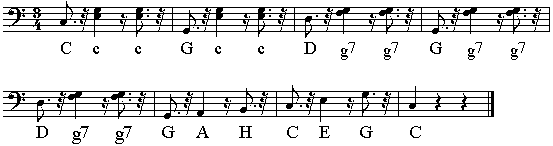
JavaScript is not functioning on your Pc? Click here to start the midi files.
For most alpine waltzes this is true only within limits. The more 1/8th notes such a waltz melody has, the more they are like the style of a fast “Steirer” or “Ländler”, therefore the more they approach the exact metronome beat.
Similarly for Polka und Boarisch: barely noticeably the 1st accompanying chord „brakes“, comes a bit later than it would be compared to the exact beat of the metronome. Especially with fast polkas the bass “steps on the gas” apparently trying to accelerate, while the accompanying chord “brakes” again.

JavaScript is not functioning on your Pc? Click here to start the midi files.
The March always comes in exact walking cadence. But what happens with the 1/8 notes in between each step, is not easy to define exactly, there can be some warping again.
Ländler (8 measure count) or Steirer (mainly 1/8th notes) are mainly played in exact metronome time, but the fundamental bass may be played a bit wider, the first accompanying chord shorter, and the second again a bit longer. The closer such a Ländler gets to a waltz (also known as half waltz, 16 measure count, longer notes). The more the rhythm gets close to the waltz.
The Mazurka has to be played in the exact metronome beat, with short notes. For compensation you find a lot of small dotted notes.
The Jodler, sung or played with instruments, does not need any metronome. Here a complete freely improvised rhythm with broad tones, but as well with faster passages, then again with “Ritardando or Fermate” belongs. It should only be accompanied with fundamental basses, without accompanying chords. Similar technique applies with many songs.
All that has been said is not to be treated as a must. It all depends on the style of melody as well. In folk music there are no strict rules. You will find passages and melodies in which all this will not fit, you will have to do things a different way. Some waltzes are more like fast Ländler, with others some passages must be played in exact metronome beat. This has to be tested by one’s self with every tune. Mainly one should listen end explore how other musicians play the tune.

[Deutsche Version]



